
French police fired tear gasoline at protesters on Saturday as authorities stepped up safety throughout main cities in a bid to stop a repeat of final week’s riots throughout recent demonstrations over the rising cost of living.
In Lyon, officers used tear gasoline to disperse round 150 protesters after they briefly tried to dam a highway close to town centre, the place demonstrations had been banned.
‘The police are actually cell… They arrive and disperse marches earlier than they even type,’ mentioned a 21-year-old scholar who attended the protest.
Elsewhere, police seized weapons and gasoline masks forward of the newest demonstrations as shopkeepers braced for additional unrest and 70,000 riot officers had been deployed throughout France.
Authorities are below stress to keep up order after accusations they misplaced management in some cities final weekend, whereas additionally going through scrutiny over crowd-control techniques that left a number of youngsters significantly injured.
Final weekend, protests turned violent throughout the nation, with city halls stormed, outlets looted and the vacationer data centre in Lyon and the city corridor in Limoges set ablaze.
Officers have appeared outnumbered and overwhelmed after the demonstrations widened from dissatisfaction round faculty circumstances to embody rising residing prices and normal malaise with the federal government.
Some 135 folks have been arrested nationwide to this point on Saturday.
Forward of this weekend, police in Paris seized numerous ‘prohibited supplies’ together with knives, gasoline masks, an angle grinder, a katana, batons and googles.
In addition they made a number of arrests, with the prefecture for town saying authorities organised ‘huge checks to discourage those that may come to the capital with dangerous intentions’.
Members of the gilets jaunes joined college students and commerce unionists as they took to the streets, however President Emmanuel Macron this week introduced a crackdown on permitted protest.
It got here as related protests had been held in cities throughout Europe together with Brussels, Belgium and Tirana, Albania.

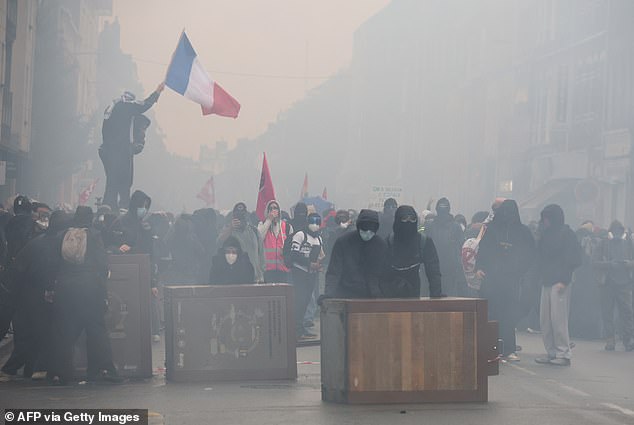
Protesters make a barricade as one holds a French flag in Lille on Saturday

Police in Lyon fired tear gasoline on Saturday to clear a gaggle of round 150 protesters from an areas the place demonstrations are banned

A demonstrator makes an attempt to kick away a fuming tear gasoline pellet amid a cloud a of tear gasoline throughout an illustration in Lyon on Saturday

A protester holds a microphone in Orléans, France, on Saturday

French riot police deployed in Orléans on Saturday mid a protest in opposition to Le Pen’s RN social gathering

Following 635 checks, quite a few prohibited objects have been seized and several other arrests have been made

Police confiscated weapons together with knives in a crackdown previous to right this moment’s protests in Paris

Protesters are seen amid heavy tear gasoline fired by police in Lyon right this moment

Police preserve a heavy safety presence in central Lyon, southeastern France, right this moment

Retailers had been boarded up on Saturday morning forward of one other day of protest in Paris

French riot law enforcement officials on the Place de la Bastille in Paris, France on Saturday, after evacuating it

French gendarmes stand amidst tear gasoline throughout a protest in Nantes, France on Saturday
He mentioned solely demonstrations organised by recognised commerce unions will likely be allowed to go forward right this moment, and cities together with Lyon, Good and Montpellier have banned protests from happening right this moment fully.
In the meantime in Orléans, as much as 40,000 folks had been anticipated to collect to protest in opposition to the nation’s hard-right social gathering Rassemblement Nationwide, which has a two-day convention within the metropolis.
Organisers mentioned round 26,000 folks turned out, however police mentioned the determine was nearer to 13,000.
In Nantes, water cannon and tear gasoline had been deployed to stop protesters getting into areas the place demonstrations are forbidden.
Shopkeepers have boarded up their premises in Paris and different cities, whereas some areas have been in partial curfews.
Main vacationer points of interest together with the Louvre, Orsay and Picasso museums are all closed, whereas a house sport for PSG has been moved till Monday and various metro stations are shut.
Whatever the crackdown by Mr Macron, a whole lot of demonstrations are nonetheless anticipated right this moment, with a web site related to the gilets jaunes itemizing 500 protests and 200 different actions.
In Orléans, outlets had been boarded up, roads sealed off and three,000 police and gendarmes deployed as town, 70 miles south of Paris, braced for potential hassle.
Protesters descended on town early within the morning because the RN’s Marine Le Pen and her social gathering president Jordan Bardella maintain a two-day congress this weekend to formally launch their marketing campaign to seize the French presidency subsequent 12 months.
The protest march, initially resulting from begin outdoors town’s Gothic cathedral, has been rerouted away from the historic centre of Orléans, whereas riot police have been deployed in power to maintain the 2 rival camps aside.

A protester carrying a Spiderman masks holds a pink smoke flare throughout an authorised demonstration organised by labour unions in Paris on Saturday

A protester wearing black is seen in Lyon on Saturday

Protesters participate in an illustration ‘in opposition to racism, fascism and imperialism’ in Orléans

Protesters in Orléans on Saturday as they protested in opposition to France’s hard-right social gathering Rassemblement Nationwide

View of a motorbike retailer with show home windows protected by wood panels in Paris forward of nationwide protests anticipated later

French troopers are seen on patrol close to the Arc de Triomphe in central Paris on Saturday

Pictured: An influence instrument seized by police in Paris forward of this weekend
In Paris, troopers from an anti-terrorism navy unit patrolled the Champs-Elysees avenue whereas police vans circled the Arc de Triomphe, seeking to shield a few of the capital’s most well-known websites from any repeat of the unrest that shook France final week.
Police mentioned greater than 100 protesters and residents had been injured in Paris final Saturday. Authorities haven’t launched a nationwide damage tally. About 2,400 folks had been arrested throughout France that day.
Officers have additionally confronted criticism after a 17-year-old woman misplaced an eye fixed whereas taking part in a protest in Mulhouse final Saturday, whereas a 17-year-old boy misplaced a hand in Saint-Etienne. Different youngsters have suffered disabling accidents throughout weeks of highschool blockades and avenue demonstrations.
And right this moment, an investigation was opened after a photographer was severely injured within the leg by a police grenade in central Paris final Saturday.
French police forces are outfitted with batons, tear gasoline, sound grenades and foam-round launchers, in addition to riot shields outfitted with highly effective strobe lights designed to disorient protesters.
‘Intermediate-force weapons are defensive response instruments that permit regulation enforcement officers to answer a menace in a graduated and proportionate method,’ French Nationwide Police mentioned in an announcement.
However critics, together with households of injured youngsters, say the police have been too heavy-handed.
Some have referred to as for bans on foam-round launchers, tear gasoline and stun grenades, echoing calls for made by human rights teams for the reason that violent 2018 gilets jaunes – ‘yellow vest’ – protests.
Earlier this month, Amnesty Worldwide referred to as for a everlasting ban on all stun grenades, saying they’re designed to shock, disorient and sow panic, and that some could cause everlasting listening to loss and life-changing accidents from blasts and shrapnel.
The usage of such weapons displays a broader shift in French policing towards maintaining officers at a distance from protesters, mentioned Jean-Marie Godard, an writer specializing in France’s inner safety.

ALBANIA: A protester subsequent to burning trash cans throughout an anti-government protest by college students in Tirana

ALBANIA: A water cannon sprays protesters in Albania on Saturday afternoon

ALBANIA: A protester throws rocks at police throughout an anti-government rally, in Tirana

French gendarmes and specialist intervention automobiles are seen close to the presidential palace in Paris on Saturday

French gendarmes stand subsequent to a multipurpose intervention automobile outdoors the Nationwide Meeting in Paris

French President Emmanuel Macron mentioned this week solely demonstrations organised by recognised commerce unions will likely be allowed to go forward right this moment
Within the early 2000s, France’s conservative authorities moved away from group policing, which emphasised foot patrols and engagement with residents, towards specialised riot-control models.
Folks throughout France’s political spectrum remorse abandoning the group policing mannequin, Mr Godard mentioned.
French policing right this moment differs from that in lots of different European nations, in accordance with Laura Keesmann, a sociologist on the College of Antwerp who led a wide-ranging comparative research of policing strategies in France, the UK, the Netherlands and Sweden. Within the different nations studied, police typically interact instantly with demonstrators, typically mingling with crowds to defuse tensions, she mentioned.
‘That’s simply actually, actually not the case in France,’ she mentioned. ‘There’s rather more of an authoritarian method of policing.’
Ms Keesmann confused, nonetheless, that French police face unusually militant and typically violent protesters.
On the eve of final Saturday’s protests, Inside Minister Laurent Nuñez mentioned his directions had been ‘very clear: the police and gendarmes ought to be capable of use the whole thing of the intermediate weapons at their disposal’.
France has greater than 250,000 nationwide law enforcement officials and gendarmes. Police typically function in cities, whereas gendarmes normally cowl rural areas and smaller cities. Each forces fall below the Inside Ministry, which mentioned 997 officers and gendarmes had been injured throughout Saturday’s unrest, seven of them significantly.
Mr Godard mentioned protest actions have change into more and more decentralised as labor unions have misplaced affect over demonstrations, drawing a wider vary of contributors, together with radical teams.
French authorities have blamed a lot of the latest violence on far-Left radicals, accusing them of orchestrating clashes with police and concentrating on public buildings. Others took benefit of the unrest to loot companies, authorities mentioned.
Whereas protests in France have claimed most worldwide consideration, Milan is among the many many different European cities the place protests are additionally scheduled Saturday, from Portugal to Albania.
Premier Giorgia Meloni introduced a raft of measures, together with sending a further 500 troopers to Milan, and more durable penalties for minors, who police mentioned made up a big a part of the violent protesters.
The five hundred troopers come along with a whole lot already stationed there, and can assist about 5,000 police and different regulation enforcement personnel.
Authorities are conducting drone surveillance, checks at railway stations, rapid-response models and on-line monitoring for potential calls to violence.
Milan Mayor Giuseppe Sala has mentioned he’s involved a couple of repeat of violence this weekend and expressed assist for the deployment of extra troopers.
Rioters final weekend smashed their method into shops, concentrating on sneakers, athletic put on and sporting items on streets that run off town’s central Duomo sq..
Officers mentioned safety measures on Saturday would prolong past town middle amid issues protesters might transfer into different neighborhoods to evade closely policed areas.
Valter Mazzetti, secretary normal of the Fsp police union, advised The Related Press that troopers might present speedy reinforcements, however not resolve police staffing shortages, noting that managing demonstrations requires specialised police coaching.
Protection Minister Guido Crosetto mentioned in a social media publish that the troops lacked key instruments accessible for public-order operations, and that troopers had been solely not too long ago allowed to make use of plastic restraint ties and solely in areas round practice stations, not all through town. They aren’t approved to hold pepper spray or tasers, he mentioned.
Milan police say final week’s violence and looting concerned about 2,000 very younger protesters, numerous whom had been ‘naturalized, second-generation Italians,’ alongside overseas nationals. Over two days, police arrested 45 folks, 34 of them minors.
Milan’s welfare councilor Lamberto Bertolé advised the AP that extra investigation is required to grasp the backgrounds and motives of the younger individuals who joined the looting.
‘Many younger folks more and more lack a way of belonging and prospects for the long run. A part of our society feels excluded, amid social and financial inequalities,’ mentioned Bertolé, a member of the center-left Democratic Occasion.
Safety was additionally heightened in Rome, the place authorities locked down luxurious purchasing streets and stepped up controls across the Circus Maximus and Piazza del Popolo forward of deliberate demonstrations, together with one by right-wing college students.
An anti-war march is scheduled to start out within the early afternoon on the central Piazza della Repubblica, and there are issues over attainable infiltration by violent teams.
Organizers sought to distance themselves from potential unrest, urging contributors to maintain their faces uncovered and arms seen.
Except for Rome and Milan, demonstrations have been referred to as in a minimum of seven different cities. The newly fashioned ‘October 17 Motion’ has been the principle driver alongside scholar federations, grassroots commerce unions, and anti-war coalitions.