
Britain may very well be left susceptible to accusations of ‘genocide’ if the UN’s prime court docket accepts a looser definition of the time period, authorized and navy specialists have warned.
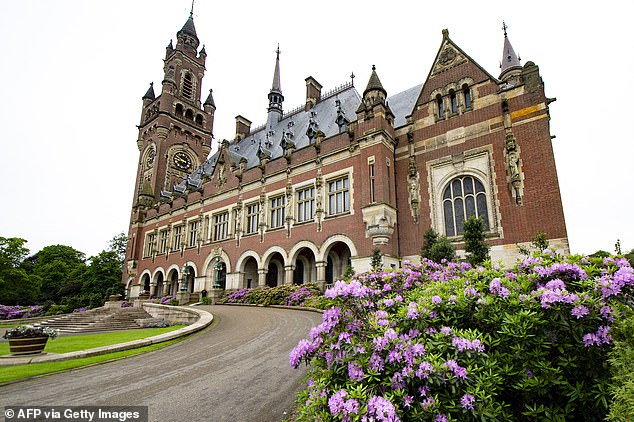
The Worldwide Courtroom of Justice (ICJ), based mostly in The Hague, is because of ship a judgment this week on whether or not Myanmar dedicated genocide towards its Rohingya minority.
It’s anticipated to be one of the vital moments in worldwide regulation for the reason that finish of the Second World War.
The landmark case might set a brand new Twenty first-century benchmark for genocide with far-reaching implications.
However a brand new paper, revealed as we speak by the Coverage Alternate assume tank, argues towards reducing the usual of proof for locating that genocide has occurred.
The authors warn in regards to the penalties for Britain’s Armed Forces of blurring the road between genocide and the atypical legal guidelines of wars.
In addition they observe genocide claims are already being made towards the UK over previous occasions, with issues they might transfer from political argument into courts of regulation.
The report factors to the Irish potato famine within the mid-Nineteenth century and the Mau Mau insurrection in Kenya within the Nineteen Fifties as hisorical occasions which have seen Britain accused of genocide.

The Worldwide Courtroom of Justice (ICJ), based mostly in The Hague, is because of ship a judgment this week on whether or not Myanmar dedicated genocide towards its Rohingya minority
Ex-ambassador Sir John Jenkins, worldwide regulation specialists Dr Tom Grant and Dr Yuan Yi Zhu, and former RAF officer Air Marshall Edward Stringer are the paper’s authors.
In addition they warn that malign actors comparable to Russia and Iran, in addition to their proxies, are already weaponising genocide allegations.
Their report highlights how the Myanmar case may very well be cited as authority when the ICJ considers different ‘genocide’ allegations, together with South Afica’s claims towards Israel over Gaza.
‘Misuse of the phrase ‘genocide’ complicates diplomacy and navy operations, problematising operations from airstrikes to counterinsurgency, to navy cooperation, to weapons gross sales,’ they wrote.
‘Western democracies are the supposed viewers of false claims of genocide, as a result of public stress in Western democracies impacts international coverage, whereas in autocracies it doesn’t.
‘Accepting these claims means letting tendentious notions propagate, undermining the ethical foundation of our international coverage.
‘Erasing the excellence between the vary of worldwide humanitarian regulation guidelines and the prohibition of genocide exposes British politicians, policymakers, and repair members to potential legal responsibility.
‘Likewise, it opens the best way to the intense legalisation of warfare, complicating navy operations and making it more durable to finish conflicts.’
The authors added: ‘Utilizing the time period for rhetorical functions to sentence acts that fall in need of genocide dangers diluting its impression and weakening responses to actual situations of genocide.
‘The latest transfer by Eire on the ICJ to scale back the brink for a discovering of ‘genocide’, such that the time period would seize Israel’s conduct in Gaza, is a part of this broader development.’
In a foreword to the report, Dmytro Kuleba – a former international minister of Ukraine – urges worldwide states to carry quick to the established understanding of genoicde.
He notes how Ukraine resisted the temptation to decrease the usual of proof in its personal proceedings towards Russia.
‘The toughest half was resisting temptation,’ he wrote. ‘The pressure of the conflict and the temper in Ukrainian society pushed us to reply Russia’s accusation with one simply as free.
‘We on the international ministry resisted it. We didn’t ask the Courtroom to search out Russia responsible of genocide.
‘We requested it to declare that Ukraine had dedicated none, and that Russia had no proper to make use of the Conference as a pretext for conflict.
‘A decrease bar would have helped Moscow greater than us, as a result of it could have put our case on the identical shelf as Russia’s invented one.’