Australian owners have been hit with one other mortgage blow after the Reserve Financial institution lifted rates of interest by 1 / 4 of a share level, pushing borrowing prices to a recent excessive because it battles cussed inflation.
A 0.25 percentage-point improve takes the money charge from 4.60 per cent to 4.85 per cent, its highest stage for the reason that international monetary disaster in 2008.
The choice means a borrower with a typical mortgage will face one other improve in month-to-month repayments, piling recent stress on already stretched family budgets.
Canstar knowledge insights director Sally Tindall mentioned Australia could also be revisiting 2008-era rates of interest, however at this time’s debtors have far larger mortgages to cope with so the fact is way tougher.
She mentioned the typical new owner-occupier mortgage has almost tripled, from $254,000 in November 2008 to $731,000 at this time, up 188 per cent, whereas the median property worth has risen by 129 per cent, with it now sitting at $884,855.
‘For somebody with a $600,000 mortgage, one other charge hike will imply discovering an additional $92 a month to clear their new minimal repayments. Nonetheless, throughout what’s now 5 hikes for the 12 months, the whole improve can be a jaw-dropping $456,’ she mentioned.
‘The stress is de facto beginning to mount and it is not simply on our central financial institution,’ she mentioned.
‘Debtors are already underneath excessive monetary stress after 4 charge hikes this 12 months. If the RBA ratchets up the money charge as soon as once more, some will hit their monetary ceiling.’
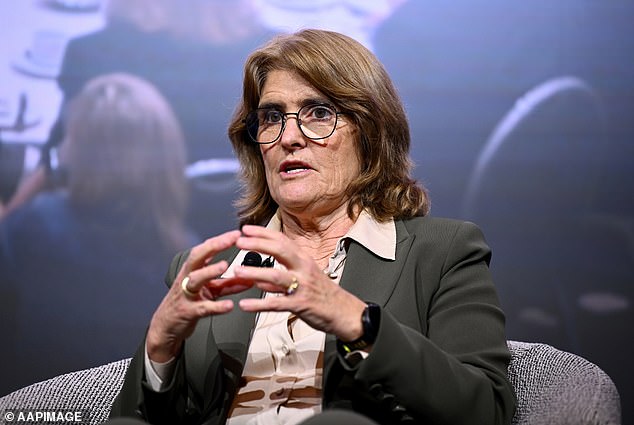
RBA governor Michele Bullock (pictured) and her board have lifted the money charge to 4.85 per cent, its highest stage for the reason that international monetary disaster in 2008
Canstar knowledge insights director Sally Tindall (pictured) mentioned Australia could also be revisiting 2008-era rates of interest, however at this time’s debtors have far larger mortgages to cope with
‘When is sufficient, sufficient?’ Reserve Financial institution boss solutions brutal query about risk of ‘six extra charge hikes’ – and warns Aussies: You will really feel such as you’re in recession
Reserve Financial institution governor Michelle Bullock has refused to place a ceiling on rates of interest, warning the central financial institution will do ‘what we have to do’ to carry inflation underneath management.
Bullock was pressed on how rather more stress Australian households might stand up to after the RBA delivered 5 rate of interest rises this 12 months.
It comes as Judo Financial institution’s chief financial adviser, Warren Hogan, predicted a ‘worst case state of affairs’ of six extra charge hikes for Australia within the subsequent two years.
Bullock declined to say how excessive charges might climb and mentioned the RBA would proceed tightening financial coverage for so long as vital.
‘Effectively, we might want to increase rates of interest to the extent that we have to, to get inflation down,’ she mentioned.
‘I do not understand how excessive that’s. I do know we have completed 5 hikes this 12 months, and that has nonetheless received one other 12 months to play by means of. As I’ve already mentioned, that also has one other 12 months to play by means of.’
Bullock mentioned economists remained divided over the long run course of the financial system.
‘So, will we want extra? I do not know. Warren Hogan is one voice. There are different voices saying, truly, we’re heading into recession territory and we will have to begin dropping charges after we’ve overdone it.
‘One factor all these folks have in widespread is that they’re all solely sure. I’m not, and I admit that.
‘We do our greatest with our forecasts. We now have to do forecasts as a result of we do not need to be backward-looking. We now have to be wanting ahead. However they’re unsure, and issues change.
‘Again in February, we weren’t anticipating a battle within the Center East. So issues occur.
‘I am not going to reply on to the query of how excessive rates of interest can go. I would solely say that we are going to do what we have to do to get inflation down.’
How rather more you may be paying in your mortgage
A 0.25 share level improve will add $92 to the month-to-month repayments for a borrower with a $600,000 mortgage and 25 years remaining, in response to Canstar.
This is able to take the cumulative improve throughout the 5 hikes since February to $456 a month for this borrower.
RBA governor Michele Bullock warns that folks will really feel just like the financial system is in recession attributable to newest charge hike
RBA governor Michele Bullock has warned that folks will really feel just like the financial system is in recession on account of the newest charge hikes.
‘Our central forecasts don’t see us going into recession, however it does see development slowing fairly markedly,’ Bullock mentioned.
‘It exhibits that consumption is kind of sluggish, and I believe that’s going to make folks really feel prefer it’s a recession as a result of they really feel poorer, their spending can’t develop in a short time as a result of their incomes aren’t rising in a short time, and this can be a manifestation of the shortage of productiveness development and the truth that we’ve had this large provide shock imposed upon us, and we’re all poorer.
‘We don’t need to push the financial system into recession. We do have a twin mandate, and though, for the time being, we’re specializing in inflation… we haven’t overlooked the truth that we need to attempt to preserve, if we will, the features within the labor market.’
Methods to lower your mortgage rate of interest regardless of the RBA rising them at this time
Canstar.com.au analysis exhibits debtors who took out an owner-occupier mortgage 5 years in the past and haven’t renegotiated their mortgage since might discover themselves on a charge of seven.34 per cent on account of at this time’s hike.
But a borrower with $600,000 remaining on their mortgage with 25 years remaining might probably save simply over $9,000 over the following two years by switching to a aggressive charge of 6.49 per cent, even after permitting for $1,150 in switching prices.
How a lot you can save by switching banks:
What the RBA mentioned concerning the charge rise
The Reserve Financial institution financial institution blamed greater gas prices linked to the Center East battle, stress inside Australia’s financial system and the bogus intelligence growth for rising inflation.
It mentioned companies have been going through greater prices and plenty of have been ‘both rising the costs of their items and providers in response or wanting to take action’.
The push to spend money on AI was additionally pushing up expertise costs.
‘AI-related funding is driving speedy development in costs for technology-related items,’ the financial institution mentioned.
Inflation is now anticipated to remain above 3 per cent till late 2027 – about 9 months longer than beforehand forecast.
The board warned there was ‘an rising threat that greater inflation expectations will turn out to be embedded’, that means folks and companies might begin treating larger worth rises as regular.
The speed rise got here regardless of indicators that earlier will increase have been already taking a toll.
‘The financial system is slowing, housing costs have fallen considerably and the unemployment charge has risen,’ the financial institution mentioned.
It expects greater borrowing prices and falling home costs to place extra stress on family spending and homebuilding. Unemployment can be anticipated to rise greater than beforehand forecast.
Even so, the board mentioned one other improve was wanted to assist carry inflation down.
Six members voted to lift charges, whereas three wished to depart them at 4.60 per cent.
Iran conflict a ‘handy scapegoat’ for Australia’s inflation downside
International X ETFs senior funding strategist Marc Jocum says the Iran conflict has turn out to be a ‘handy scapegoat’ for Australia’s inflation woes, warning that the issue is usually homegrown.
‘It’s actually including gas to the hearth, however that fireplace was burning properly earlier than the newest geopolitical shock. Solely round a 3rd of Australia’s inflation basket is assessed as tradable overlaying items uncovered to worldwide commerce and competitors, similar to gas,’ Jocum mentioned.
‘The overwhelming share of the basket is non-tradable, highlighting that the overwhelming majority of Australia’s inflation downside is homegrown. It was encouraging to see the RBA explicitly acknowledge this in its newest assertion, noting that home capability pressures are tighter than beforehand assessed.’
Commonwealth Financial institution warns of largest housing market downturn on document
Commonwealth Financial institution has warned Australia is heading for its largest property downturn on document, with house costs forecast to fall 14 per cent from their peak earlier than stabilising late subsequent 12 months.
Change of language from the Reserve Financial institution
The Reserve Banks vote was 6-3 in favour of the hike, suggesting there’s a break up in components of the financial institution concerning the course of rates of interest.
The financial institution’s newest forecasts present trimmed imply inflation, its most well-liked measure of worth pressures is not going to attain the midpoint of its 2 to three per cent goal vary till June 2028. Headline inflation is predicted to peak at 4.5 per cent by Christmas earlier than easing.
Debtors have been provided a glimmer of hope after the RBA dropped a warning about additional charge rises from at this time’s assertion, having included it in current bulletins of charge hikes.
Aussie banks already passing charge rise onto prospects
Macquarie was first out of the blocks after the Reserve Financial institution’s newest charge hike, saying a mortgage charge improve inside a minute.
The financial institution will increase variable house mortgage charges by 0.25 share factors from November 19, matching the RBA’s fifth hike this 12 months, which took the money charge to 4.85 per cent.
‘With family budgets already feeling the pressure, at this time’s resolution by the RBA can be difficult for a lot of Australians,’ head of non-public banking at Macquarie Financial institution Ben Perham mentioned.
‘In case you are going through monetary hardship or are fearful about assembly your property mortgage repayments, please attain out to our specialist staff to grasp what monetary help choices could also be accessible.’
‘Will not repair inflation’: Brutal verdict on the RBA’s charge hike
New evaluation by The Australia Institute reveals that whereas mortgage holders are being hammered by the RBA – with a fifth rate of interest rise introduced at this time – the massive 4 banks are making document income from prospects’ ache.
The evaluation exhibits that banks now make a staggering $266,000 revenue from the typical owner-occupier 30-year house mortgage of $731,000 – up $40,000 since rates of interest begin rising earlier this 12 months.
‘The banks are doing nothing to ease the ache of consumers. Somewhat than serving to, they’re making it worse, scraping large income from people who find themselves solely making an attempt to place a roof over their households’ heads,’ mentioned Greg Jericho, Chief Economist at The Australia Institute.
‘Whereas debtors are struggling to make repayments, going backwards or, worse, dropping their houses … the massive 4 banks are cashing in on their distress.’
The evaluation reveals that the massive 4 banks now make a median of $12,200 revenue within the very first 12 months from the typical new owner-occupier mortgage.
‘That is not cash to run a department, function a web based banking system and even pay multi-million greenback salaries to executives, that is pure revenue, on prime of all that. It is obscene.
‘Proper now, a median Australian household with a median mortgage from an enormous 4 financial institution is contributing $234 every week to their financial institution’s revenue – greater than a thousand {dollars} a month going straight to an organization which persistently information multi-billion greenback income whereas prospects expertise unprecedented ache.
‘The RBA’s resolution to raise rates of interest towards at this time punishes people who find themselves already being punished by their financial institution.
‘Odd Australians – notably these underneath mortgage stress – will not be inflicting inflation by spending an excessive amount of. Inflation is being pushed by the price of gas, attributable to Donald Trump’s conflict within the Center East, and company income.
‘This brutal resolution by the RBA will not repair inflation. However it should see many respectable Australian households compelled from their houses.’
Ms Tindall mentioned she was involved some debtors could haven’t any extra buffer to fall again on.
‘The query now’s how rather more room households have of their funds. Some debtors will be capable to take up one other improve inside their present price range, however others could also be compelled to raid their financial savings.’
Former RBA economist Luke Hartigan mentioned the RBA’s earlier strategy of creating smaller, extra cautious strikes has not completed sufficient to carry inflation underneath management.
He mentioned the RBA could have little selection however to maintain tightening regardless of the financial dangers.
‘This might trigger a recession and a dramatic improve within the unemployment charge and additional falls in housing costs in early 2027,’ he mentioned.
‘Whereas inflation stays exterior the goal band it dangers inflation expectations changing into unanchored which might be very pricey to right.
‘Rates of interest are a blunt instrument for managing inflation. Governments, each state and federal, can have a extra focused position in serving to to handle inflation by lowering demand pressures within the short-term by way of elevated taxation and decreased spending whereas additionally in search of to spice up the productive capability of the financial system over the long-term.’
AMP chief economist Shane Oliver expects nationwide home costs to fall about 15 per cent from peak to trough, warning the downturn is now monitoring at its quickest tempo since 1980.
AMP chief economist Shane Oliver (pictured) mentioned Sydney, Brisbane, Adelaide and probably Perth have been more likely to expertise the steepest declines
‘Nationwide common costs are down 6.7 per cent and capital metropolis costs down 8.1 per cent from their early-year peaks,’ he mentioned.
‘The speedy decline, mixed with extra charge hikes than anticipated, rising unemployment and the structural modifications related to investor tax will increase, suggests the top-to-bottom fall is now more likely to be round 15 per cent.’
Oliver mentioned Sydney, Brisbane, Adelaide and probably Perth have been more likely to expertise the steepest declines, whereas Melbourne and Hobart ought to show extra resilient.
He expects costs to backside out within the September quarter subsequent 12 months earlier than starting a modest restoration in 2027-28, when the Reserve Financial institution is predicted to begin reducing rates of interest.
‘Whereas we expect the RBA, after one other charge hike this week, can have completed sufficient to gradual demand within the financial system and funky inflation, with 4.85 per cent more likely to mark the height within the money charge, the chance of additional hikes stays excessive,’ he mentioned.
‘In any case, RBA commentary is more likely to stay hawkish for a while and we do not anticipate charge cuts till the December quarter subsequent 12 months. Absent a disaster, significant charge aid continues to be a good distance off.’
Angus Moore, a senior economist with realestate.com.au, mentioned the speed rise will lengthen the downturn already underway within the housing market.
‘Residence costs nationally have declined for seven straight months,’ he mentioned.
Additional will increase in mortgage charges will cut back borrowing capacities once more for potential consumers, including to the downward stress on house costs
‘Additional will increase in mortgage charges will cut back borrowing capacities once more for potential consumers, including to the downward stress on house costs.
‘Nonetheless, the downturn, whereas brisk, stays an orderly adjustment pushed by rising charges and affordability pressures, quite than a distressed housing correction.
‘Labour market circumstances stay resilient by historic requirements, mortgage arrears charges stay low, few debtors are in unfavorable fairness, and plenty of households retain substantial reimbursement buffers.’